


Michigan Salmon Season Family Tradition and the Big Run Ahead

The first week of August always sneaks up on us. One minute we are talking about summer plans, and the next thing we know it is back-to-school (homeschool)shopping, a few football games, cooler mornings, and that familiar feeling in the air.
Salmon season is coming.
In our house, that is not a small thing. It is not just a weekend hobby or a reason to dust off the rods. Michigan Salmon Season Family Tradition and the Big Run Ahead means food for the year, freezer bags stacked tight, jars of canned salmon on the shelf, meals we can count on, and even carefully prepared fish for the dogs.
More than that, it means family time.
It means early mornings, cold hands, tired kids, loud stories, quiet riverbanks, and the kind of memories that do not need a camera to stick. Salmon fishing in Michigan has a way of becoming more than fishing. It becomes a marker on the calendar, a season inside a season, and for many families, a tradition worth protecting. I was honored to be invited by my older cousin who quickly showed us the ropes.

August means it is time to start getting ready
By the first week of August, salmon season still feels a little far away, but it really is not. School starts. Football starts. The evenings shorten. Then suddenly everyone is asking where the net is, and whether the freezer has enough room.
That is how it goes every year.
The best part of being early is that there is still time to get organized without rushing. Salmon season can be hard on gear, hard on sleep, and hard on plans if everything gets left until the last minute.
A good August prep list looks something like this:
Check rods, reels, and line for wear
Sharpen or replace hooks
Find waders, boots, rain gear, and warm clothes
Clean coolers and fish bags
Make sure knives are sharp
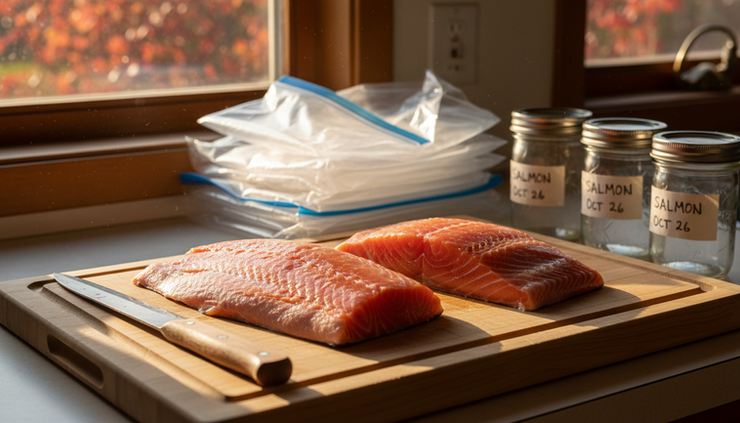
Stock freezer bags, vacuum seal rolls, jars, lids, and labels
Review current Michigan fishing regulations
Make room in the freezer before the first fish comes home
That last one matters more than people think. A big salmon takes space. A few good trips can fill a freezer fast. If the goal is to feed the family through the year, the prep starts before the first cast.
We also start talking with the kids before the run really gets going. Some of it is practical, like safety near fast water and listening when an adult says to step back. Some of it is about respect. Respect for the fish, the river, other anglers, and the fact that if we harvest it, we use it. We do not take a life unless we eat it and we use as much of it as possible.
That is one of the biggest lessons salmon season teaches.
The Michigan salmon run is worth the wait
Michigan has a salmon culture all its own. The Great Lakes are not oceans, but when the salmon run starts, they sure can feel big enough. Chinook and coho salmon draw anglers from all over the state, from Lake Michigan piers and river mouths to inland river stretches where fish push upstream in the fall.
The run usually builds as summer fades and water temperatures begin to change. Weather, rain, river flow, lake conditions, and timing all play a part. Some years feel early. Some feel late. Some feel like everyone is guessing until the fish are suddenly there.
That uncertainty is part of the pull.
Michigan’s salmon were introduced into the Great Lakes decades ago and became part of a new fishing tradition. Today, for many families, the run is woven into the rhythm of fall. People plan time off work. Kids learn which rivers their grandparents fished. Neighbors trade reports. Tackle shops get busy. Coolers ride in truck beds again.
There is a feeling to it that is hard to explain unless you have lived it.
The run is not just about catching fish. It is about standing near the water before daylight and hearing someone whisper, “They’re in.” It is about watching a kid hook into a salmon for the first time and realize that this is not bluegill fishing. It is about the shake in the rod, the sound of drag, and the sudden teamwork when someone yells for the net.
It is also about patience. Salmon do not care about our schedule. They do not care if we have school in the morning or dinner waiting at home. They move when conditions tell them to move.
That is why the run feels so special. We do not control it. We show up, pay attention, and try to be ready.

In our house, salmon means food for the year
When people ask why salmon season matters so much, the answer is simple. It helps feed us.
Fresh salmon dinners are only the beginning. If we are blessed with a good season, that fish becomes part of the whole year. We freeze it. We can it. We smoke it. We make patties. We make dips. We save portions for quick weeknight meals. We prepare some carefully for the dogs.
Nothing gets taken for granted.
There is a deep satisfaction in opening the freezer in January and pulling out fish that came from a fall morning on a Michigan river. It carries the memory with it. The cold air, the muddy boots, the kids asking if we can go again tomorrow, the ride home with everyone tired and hungry.
That food has a story.
Fresh salmon dinners
The first salmon of the season usually deserves a fresh meal. Simple works best. A little butter or oil, salt, pepper, lemon, garlic, maybe a few herbs, and a hot pan or grill.
Some favorite ways to cook fresh salmon include:
Grilled fillets with lemon and garlic
Baked salmon with butter and herbs
Pan-seared portions with crispy edges
Salmon tacos with slaw
Salmon chowder for cold evenings
Salmon patties with crackers, egg, and seasoning
Fresh fish is the reward after all the work, but we try not to use it all right away. A good season is about planning.
Frozen salmon for easy meals
Freezing salmon is one of the best ways to keep it useful through the year. We like portion-sized packs because they thaw faster and fit real meals better.

The key is to protect the fish from air. Vacuum sealing works great. Freezer bags can work too if the air is pressed out well. Labeling matters. Put the date and the cut on the package so nobody has to guess later.
A freezer full of mystery fish is not helpful. A freezer full of clean, labeled salmon portions is a blessing.
Canned salmon for the pantry

Canned salmon might be the most underrated part of the whole season. It takes work, but it gives back all year.
Pressure canning is the safe method for fish. It has to be done with proper equipment, tested recipes, and current food safety guidance. This is not the place to guess or cut corners.
Once it is done right, canned salmon becomes fast food in the best way. It can turn into salmon patties, sandwiches, rice bowls, pasta, spreads, or a quick lunch when nobody wants to cook.
There is something comforting about seeing those jars lined up. They represent time on the water, work in the kitchen, and meals already handled.
Smoked salmon for sharing

Smoked salmon never lasts long. It is too easy to pick at. A batch can disappear during a football game before anyone admits they had “just one more piece.”
Brining, drying, and smoking take patience, but the flavor is worth it. Some people like it sweet. Some like it peppery. Some like a firmer smoke, while others keep it softer. My husband is the smoker of the fish and I am the canner. We have a smokehouse on our farm and it makes everything smell awesome the week after fishing.
That is the fun of it. Every family seems to have a way they like best.
Preparing salmon for the dogs takes extra care
In our house, salmon also helps feed the dogs. That said, dog food prep needs care. Dogs should not get seasoned scraps, cooked bones, onion, garlic, heavy salt, or anything questionable from the cleaning table.
For our dogs, fish is treated like food, not waste.
A safer approach is to use clean portions, cook them plain, remove bones carefully, and freeze in small servings. Some families mix cooked salmon with regular dog food as an occasional topper. Others portion it out for special meals.
It is smart to talk with a veterinarian before adding much salmon to a dog’s diet, especially for dogs with allergies, pancreatitis, weight issues, or other health concerns.
The rule in our house is simple: if we would not eat it for ourselves, it does not go to the dogs either.
That mindset keeps everything respectful. The fish gave us food. We do right by it from river to freezer to bowl.
The best part is the family time
The kitchen prep matters. The freezer matters. The canned salmon and dog food matter. But none of it would mean the same without the people.
Salmon season brings everyone into the same story.
Someone is tying knots. Someone is packing snacks. Someone is asking if the kids have gloves. Someone is making coffee in the dark. Someone is reminding everyone to use the bathroom before we leave because there will not be a clean one where we are going.
Then, after the trip, the house turns into a work station.
Fish get cleaned. Bags get labeled. Jars get washed. The sink fills and empties. The kids wander in and out, watching, asking questions, sometimes helping more than they realize.
Those are the moments that stay.
Not every child will grow up to fish every fall. That is okay. The point is not to force the tradition. The point is to give it to them honestly. Let them feel the cold mornings. Let them understand where food comes from. Let them see that harvesting fish comes with responsibility.
Tradition is not just repeating what came before. It is teaching why it mattered.
Right now, that responsibility is mine. I am the next link in the chain. The people before me passed down the excitement, the skills, the stories, and the respect. Now it is my turn to make sure my children know how important it is.
Not because salmon are just fish.
Because this season teaches work, patience, gratitude, and family.
What we teach the next generation
Kids learn more than we think during salmon season. They hear how adults talk when fishing is slow. They watch how we treat other anglers. They notice whether we keep only what we can use. They see if we clean up after ourselves.
Those lessons matter.
A child who learns to fish also learns how to wait. A child who helps process salmon learns that food does not start at the store. A child who watches a parent or grandparent handle a fish with care learns respect without needing a lecture.
Some of the best traditions are built from small jobs:
Carrying the lighter tackle bag
Holding the net until needed
Writing dates on freezer bags
Counting jars on the counter
Helping rinse gear
Listening to old stories on the ride home
At first, those jobs may not seem like much. Years later, they become the memories.
I still believe the best way to pass something down is to let kids feel useful. Give them a job they can do. Let them be part of the season, not just passengers in it.
Getting ready for the big run ahead
The big run ahead brings a little bit of chaos, but the good kind. The kind that has everyone checking the weather. The kind that makes a normal weekday feel like it might turn into a memory. The kind that gets passed down because people cared enough to keep showing up.
This year, like every year, we will get the gear ready. We will make freezer space. We will check the jars and lids. We will talk to the kids about safety and respect. We will hope for cool nights, good water, and a chance to put food away for the year.
And when that first salmon hits, all the waiting will make sense again.
Michigan’s salmon run is more than a fishing season for our family. It is food, work, gratitude, and time together. It is the past reaching forward. It is the next generation standing on the bank, watching closely, waiting for their turn to hold the rod. It is Something that we are honored to be a part of.
Where will you fish this fall..Wilson Wonders


Comments